
Read this article on Substack!
At the heart of everything in the universe—your phone, the air, the stars, your body—is the atom. Atoms are composed of three core particles: protons, neutrons, and electrons. These building blocks of matter first emerged from the fiery origins of the universe itself, formed in the wake of the Big Bang. Protons and neutrons are made of quarks, while electrons belong to a family of particles called leptons. These are fundamental particles, meaning they aren’t made up of anything smaller. This tiny world of particles, invisible to the eye but foundational to all existence, also holds the key to one of humanity’s most powerful—and controversial—sources of energy: nuclear power.

Some atoms, especially those of radioactive elements like uranium or plutonium, don’t hold themselves together very well. These atoms have unstable nuclei—meaning there’s an imbalance between their protons and neutrons. As a result, they undergo radioactive decay, releasing energy as they try to reach a more stable state. These elements, identified on the periodic table, are not rare in nature, but they are volatile. And with the right kind of manipulation, their instability can be harnessed—either for destruction, as in nuclear weapons, or for electricity, as in nuclear reactors.
The process that unlocks this potential is called nuclear fission. When a neutron strikes an unstable nucleus, naturally or artificially, with enough force, the nucleus can split in two, releasing a massive amount of energy—more than what the neutron delivered. Even more significantly, this split ejects additional neutrons that can go on to strike other unstable nuclei. When enough radioactive atoms are packed closely together, this reaction can become self-sustaining. This threshold point—when a nuclear chain reaction becomes continuous—is what scientists call critical mass.

Critical mass is appropriated to money conceptually via interest, or the rate and or ability for and at which your money earns money. The first thing to note is that there are a few steps necessary to set up this chan reaction in your life. If and when you create a critical mass reaction in your finances there will be a sense of freedom and responsibility that comes with the idea or realization that depending on how your finances are organized, you may not have to work again for the rest of your life.
The first thing you’ll want to do is find out how much you spend on average on a monthly or yearly basis to sustain your quality of life. Then you want to find lucrative investments that yield favorable returns and invest in them. Continue, sustain, and optimize the rate of your investment with respect to your returns to the point at which the average return on what you’ve invested exceeds your lifestyle expenses.
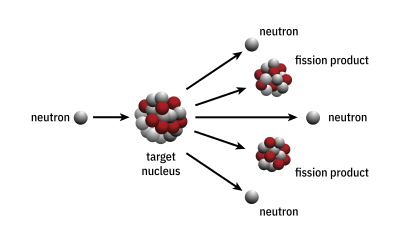
Speak to your financial advisor on how you can best set this up for yourself. The point is, however, that the moment you reach the point where your return on investment continuously and systematically is greater than your lifestyle expenses by one penny, you will have reached your critical mass. With respect to nuclear, when a fissionable material reaches critical mass this means that nuclear fission reaction is self-sustaining. In this self-sustaining state if harnessed or captured, the nuclear energy released from the fission taking place can be turned into a bomb, or stored in a nuclear reactor and used for energy like electricity.
Once you achieve critical mass, you are the end of the road. All creation needs to be taken care of. That’s why for example, the monalisa is behind glass and rope with guards. For that created work to remain it must be taken care of; otherwise it’s lost to time. You could also crash out and go in a different direction where the freedom of critical mass may become overwhelming. To go back to mona lisa, even though Leonardo da Vinci passed, his art is being kept at an art museum. Whatever you create, wealth or otherwise, if it’s not managed by you it should be managed by someone who cares and knows how to care for what needs to be taken care of. Remember that critical mass is a build up; once you are able to do virtually anything, then with great power comes great responsibility and consequences.
Subscribe to us on Substack and receive new content directly in your inbox:
Leave a Comment